
On 1 September 2026, Dr Raghuram Rajan, former RBI Governor (2012-2016) and Chief Economic Advisor to Government of India (2012-2013), questioned India’s push towards semiconductor self-sufficiency. He argued, ‘why build, when you can smuggle?’, citing the success of Russia and China in meeting their semiconductor needs through smuggling.

Let us try and understand the path our most eminent economist wants India to take (Spoiler: smuggling is not enough).
Russia: circumventing Western trade-tech sanctions
Following Russia’s annexation of Crimea in 2014, USA and the EU imposed a number of sanctions on Russia, particularly targeting key sectors of its economy like defence and energy. When it launched a full-scale invasion of Ukraine in 2022, the scope of these sanctions was expanded to more entities and sectors to deny Russia funding and critical technology to continue the war. These expanded export controls severely restricted Russia’s access to technologies such as semiconductors, computers, telecommunications, information security equipment, lasers and sensors.
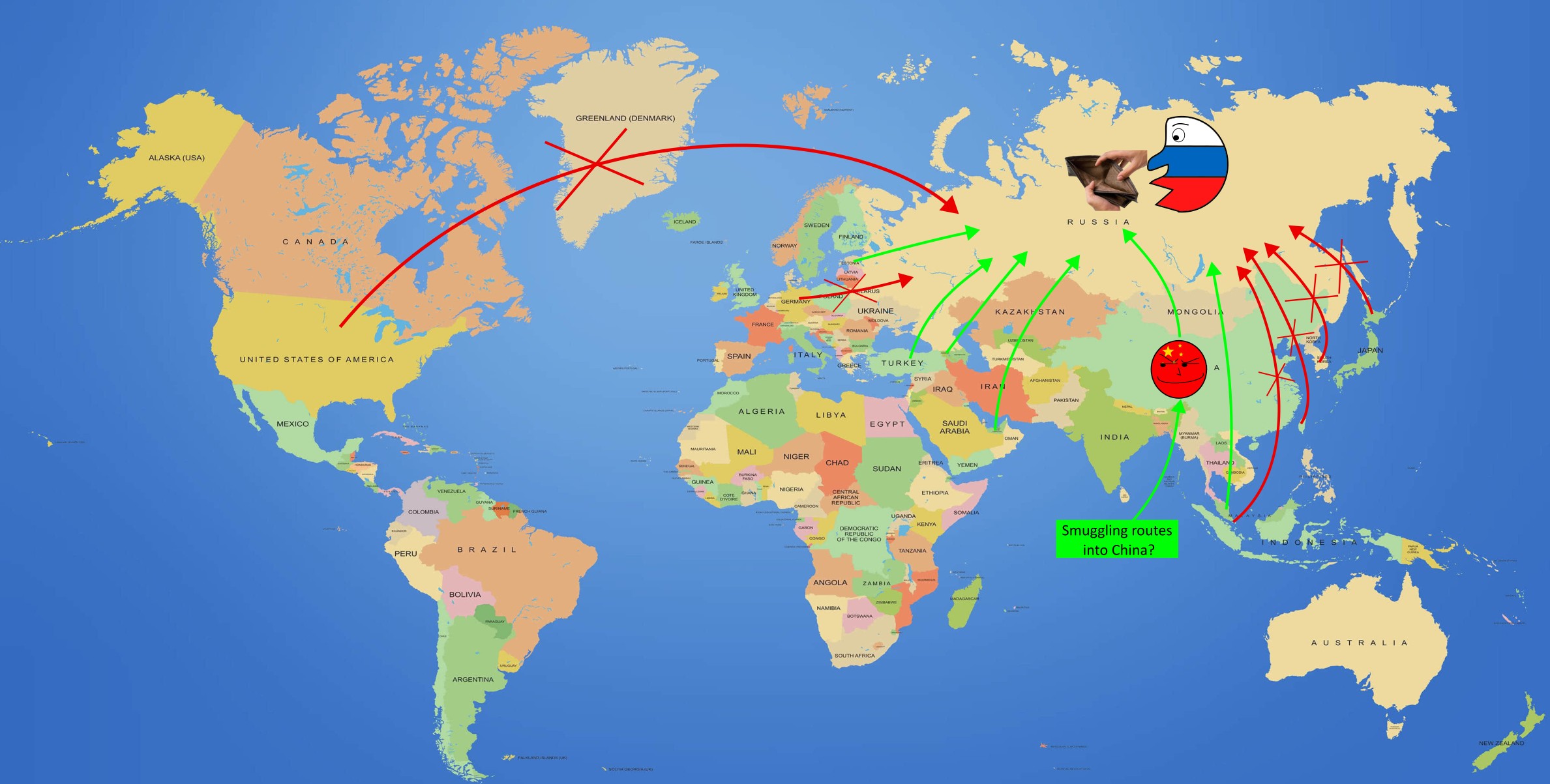
All the important players in the global semiconductor value chain – USA, EU, Japan, Singapore, South Korea, and Taiwan – have restricted exports of semiconductor technology to Russia. As a result, Russia is forced to secure chips from intermediary nations such as China, UAE, Malaysia, Turkey, Armenia, Estonia, etc. Some companies based in these countries import these products legitimately from Western fabs and then illegally re-export them to Russia with their governments generally turning a blind eye to these shipments. According to reports, nearly 80% of semiconductor chips that reach Russia come from China.
Through such smuggling, Russia has managed to circumvent Western sanctions to some extent, but it has its costs. Russia is forced to pay nearly twice as much for semiconductor chips as compared to what it used to pay before sanctions. The defect rate of the smuggled chips is very high (almost 40%) due to lack of proper quality controls, poor handling during transit, and dumping of defective or discarded stock by unscrupulous black-market sellers. Also, the constant cat and mouse game with Western enforcement agencies means frequent shifting and rebuilding of covert smuggling networks and routes as front companies get identified and blacklisted.
The sanctions have also impacted Russia’s domestic semiconductor industry by restricting supply of foreign equipment, spare parts, and maintenance services. Its domestic microchips production relies largely on two state-owned companies: Angstrem and JSC Mikron. One can add Belarus-based Integral to the list as it has crucial links with Russian military industrial complex going back to the Soviet era.
Angstrem was founded in 1963 and is based in Zelenograd (Moscow) which is known as the Silicon Valley of Russia. It is a key supplier of microelectronics to Russia’s defence sector and state corporations. In 2024, it earned the dubious honour of being Russia’s largest loss-making company with a net loss of $2.86 billion while bringing in just $60.5 million as revenue. The losses are largely due to money borrowed from the state-owned bank VEB in 2008 for an ambitious project to produce processors that ultimately failed. In 2007, its spin-off Angstrem-T purchased 130 nm fabrication equipment from AMD and, in 2012, a license from IBM to jump start mass production at 90nm process in Russia with the consent of the US State Department. The project, however, suffered delays due to US sanctions imposed after the Russian takeover of Crimea and could produce its first chips only in 2016. In 2019, VEB seized its assets and shares and later became its legal owner. In mid-2021, VEB created a subsidiary NM-Tech that took over Angstrem-T’s chips production facilities. Towards the end of 2021, NM-Tech reportedly hired some ex-employees of Taiwan’s United Microelectronics Corporation to help fabricate chips in the range of 130nm to 90nm using the AMD equipment. The Russian government supported it with subsidies and, in August 2023, VEB too opened a credit line of around $1.3 billion to finance the purchase of foreign chip making equipment. Despite all this, NM-Tech has struggled, it seems, due to the corruption within the system as well as lack of adequate funds and foreign sanctions.

JSC Mikron, too, is headquartered in Zelenograd and was founded in 1964. It is Russia’s largest chipmaker as well as the largest manufacturer and exporter of microelectronics. It is part of the Element group which incorporates around 30 companies, and which is ultimately owned by the Russian state corporation Rostec.
Around 2011, it bought chip making equipment from STMicroelectronics (STM) that could fabricate chips at 90nm process node. In March 2022, Mikron was one of several technology firms that were sanctioned by the US following the Russian invasion of Ukraine. At present, it produces chips with mature nodes ranging from 250nm to 65nm mainly for biometric passports, bank cards, and transport tickets as well as for defence systems. Russia’s National Payment Card System, also called Mir, relies on Mikron’s chips. In 2024, it began mass production of Russia’s first microcontroller MIK32 ‘Amur’ and plans to launch its improved version by 2030.
Another chipmaking company based in Zelenograd, AO PKK Milandr, too was sanctioned by USA in November 2022 for supplying microchips to Russian weapons manufacturers for cruise missiles, armoured vehicles, and Su-34 fighter bombers. Its affiliates and agents in Switzerland, Taiwan, and Armenia were also sanctioned for procuring microchips abroad that they planned to divert to Russia.
The Belarus state-owned company Integral was formed in 1971 in Minsk by merging Semiconductor Devices Plant (set up in 1963) and the Transistor Plant. In Soviet Union, it participated in key space and defence projects and was one of the biggest manufacturers of microelectronics with a workforce of more than 30,000 employees. After 1991, the company faced shutdown but was rescued by the government. The US added it to its sanctions list in 2022, but the EU imposed restrictions on it only in 2025. Reportedly, in the period between March 2022 and June 2024 it shipped over 6 million microchips to Russia estimated to be worth $130 million, increasing its net earnings fortyfold in 2024 as compared to 2021.
Russia’s roadmap for technological sovereignty
Clearly, sanctions have had a significant negative effect on Russia’s domestic semiconductor ecosystem. According to a 2022 report by a Russian consultancy firm Yakov & Partners (formerly McKinsey Russia), Russia produced around 8000 wafers per month while the monthly demand for basic level 90nm and larger microchips stood at over 30,000 wafers. The chips made by Russian fabs were of low quality and lacked many functional requirements but were still bought by public sector customers. These fabs also lacked the wherewithal to collaborate with Russian design firms such as Moscow Center of SPARC Technologies (MCST) and Baikal Electronics that had earlier produced designs for 16nm chips with TSMC.
Russia’s strategy is not just to depend on smuggling chips and chip-making tools but to push towards semiconductor self-sufficiency. In 2022, Russia launched Electronic Engineering Development Program to promote domestic production of semiconductor manufacturing equipment covering more than fifty specialised tools and materials to replace at least 70% of foreign equipment by 2030. The Russian government allocated $2.54 billion for this purpose to finance around 110 R&D projects that would cover all tools and materials needed for the semiconductor ecosystem. By international standards, however, the funds were on the lower side.
In October 2023, the Russian government announced a roadmap for semiconductor localisation by targeting mass production in Russia of chips at 65nm node by 2026, at 28nm node by 2027, and at 14nm process node by 2030. For this, the total investment planned was nearly $38.43 billion. To develop equipment and specialised materials needed for chip-making, around $1.2 billion were allocated with the aim of obtaining by 2027 tools ranging from photolithography to ion implantation systems, plasma etching clusters, and silicone growth installations.
On 24 March 2025, Zelenograd Nanotechnology Centre (ZNTC) claimed a breakthrough in developing Russia’s first 350nm-capable lithography scanner making Russia one of very few countries having this capability. Using technology different from that of ASML, Russia’s machine is based on solid-state laser rather than on gas lasers. In 2026, completion of a prototype of a 130nm lithography system in collaboration with Belarus was announced.

At a time when ASML most advanced scanners can print sub-2nm features in a single exposure, this is almost thirty years old technology that is now obsolete. Nevertheless, it is a necessary step towards development of more advanced systems and part of the three stage-10-year roadmap for the development of EUV lithography scanners that Russia had unveiled in September 2025. In the first stage (2026-28), the target is to develop 40nm process machines, followed by 28nm-capable machines in the next stage (2029-2032) eventually leading to the development of EUV machines that can produce chips at below 10nm processes in the third stage (2033-2036).
If all goes according to plan (and it is a big if, given the complex technology and materials involved), Russia could challenge ASML’s monopoly in EUV lithography tools. That would not only make Western sanctions ineffective but by exporting these to new customers, it would completely shake up the global semiconductor ecosystem.

Russian firms are already exploring export markets for these tools. For instance, the Zelenograd-based Russian company Nanotronica, which is part of the Element group, opened an Indian subsidiary Nanotronica India Private Ltd in 2025 in Bangalore to sell semiconductor equipment to Indian research laboratories and universities. This equipment is sourced from Nanotronica-owned Precision Engineering Research Institute (NIITM) and includes lithography, metrology, epitaxy and ion implantation systems, plasma etching apparatus, etc. Realising its limitations in competing with established players at present, the company is positioning itself as an additional supplier of equipment for mature technological processes to non-production facilities such as research centres and small projects with a high degree of localisation. The plan is to gradually increase its presence in the Indian market as well as to help other Russian manufacturers access it.
Thus, Russia depends on smuggling pipelines to feed its demand for chips, but its long-term goal is to escape this dependency.
Now let us turn to what China is doing in this sector.
Smuggling into China to spur ‘Made in China’
In April 2026, the US Congress Select Committee on CCP released its suggestively titled report ‘Buy what it can, steal what it must: China’s campaign to acquire frontier AI capabilities’. It found China clearly behind the US in production at scale of advanced logic chips (which perform core calculations) and high bandwidth memory (HBM) chips (which store and move data at speed). To close the gap, the report alleged that China used both licit and illicit methods to procure advanced chips.
Smuggling is a clandestine activity and, therefore, not easy to measure accurately but one report has estimated that more than 6,60,000 AI chips (Nvidia H100-equivalents) reached China by illegal channels in 2025 in violation of US restrictions. Recent reports indicate that the most advanced Nvidia Blackwell AI chips have also reached China through smuggling pipelines despite US export controls.

In January 2026, the Trump administration formally allowed the export of Nvidia’s H200 and AMD’s Instinct MI308 processors to China, subject to certain conditions and a 25% fee for the US government. Nevertheless, the exports so far have been minimal due to both US security reviews and the Chinese government’s discouragement of imports to accelerate domestic production and reduce foreign dependency. The US cleared around 10 Chinese companies to buy H200 chips, but the first confirmed delivery took place only in August 2026. The sale of H200s to China formed less than 1% of Nvidia’s $89 billion data centre revenues for the second quarter of 2026.
In the last two decades, China has engaged in intensive efforts to develop its own domestic semiconductor industry and to reduce foreign dependence. In 2014, it issued Guidelines to Promote National Integrated Circuit Industry (National IC Plan) aimed at raising Chinese semiconductor capabilities across the entire supply chain to catch up with industry leaders. A National IC Fund worth $150 billion was also set up to develop new production facilities as well as to acquire/partner companies abroad to get access to latest technologies and materials.
In 2015, the ‘Made in China 2025’ plan was launched to mobilise all resources to accelerate manufacturing in ten high tech sectors such as next generation information technology, advanced robotics, aerospace, new materials, medical devices, etc. In semiconductors, it set a very ambitious target of achieving by 2020 at least 50% self-sufficiency in 90-32nm process chips and 90nm lithography machines. For 2025, the target was 30% localisation of 20-14nm process chips and domestic production of immersion DUV scanners before moving on to making EUV lithography machines in China by 2030.

In pursuit of these targets, China tried to obtain cutting-edge technologies and IP by acquiring many Western semiconductor companies and compelling foreign companies to agree to tech transfers to get necessary approvals for entering the Chinese market. There were also allegations of IP theft through illegal cyber intrusions into foreign tech servers as well as instances of employees absconding to China with sensitive data and blueprints.
The MIC 2025 targets were too ambitious and were not fulfilled, but China’s production capacity in mature node chips (28nm or more) increased four times faster than the global demand between 2015 and 2025, accounting for nearly 50% of global capacity in 2025. As a result, Chinese imports of legacy chips declined perceptibly in recent years. Even for more advanced chips that have remained under export restrictions, domestic production has been increasing.
More than the Chinese government initiatives, according to a report, it was the post-2022 Western controls on export of semiconductor technologies to China that succeeded in catalysing ‘true Chinese chips innovation’ as opposed to the earlier way of managing through ‘reverse engineering’.
Lessons for India: dependency or technological sovereignty?
The Russian and Chinese semiconductor strategy does not revolve around smuggling chips; rather, it can be described as ‘buy what you must at present, steal what you can’t get otherwise while putting all efforts to boost domestic production and technological sovereignty across the semiconductor value chain.’
No major power can afford to be dependent on foreign countries for technology that is absolutely critical to its economic and defence infrastructure. Such a dependency can be weaponised anytime to constrain its strategic autonomy in global affairs as well as its economic progress.
If anything, the Russian and Chinese experiences show that the supply of semiconductor chips and equipment can be so easily cut-off for strategic purposes. Therefore, nations like India have no option but to build domestic resilience and strategic partnerships abroad to ensure dependable supply chains.
Dr Raghuram Rajan, we need to learn the right lessons from Russia and China. Smuggling can fill short-term gaps in critical supplies, but the long-term goal must be technological sovereignty.
Related Posts
-
ASML and Europe’s grip over Semiconductors Chokepoint: Is China chipping away at it?
-
The Curious Case of Nexperia: Strategic Technologies and Strategic Challenges
-
European Union’s Chips Diplomacy: CHIPDIPLO and Other Diplomatic Initiatives concerning Semiconductors
-
European Chips Act 2023: What is it? And Why has EU proposed a new European Chips Act 2.0?
-
What is Strategic Autonomy? And why can’t Europeans stop talking about it?
Frequently Asked Questions (FAQ)
Ques: What is Russia doing in the semiconductor industry?
Russia is growing its semiconductor industry using a combination of illegal and legal imports alongwith growing its indigenous device fabrication equipment manufacturing industry. The West’s sanctions on electronic imports has forced Russia to import from countries such as China, UAE, Malaysia, Turkey, Armenia, Estonia, etc. Some companies based in these countries import these products legitimately from Western fabs and then illegally re-export them to Russia with their governments generally turning a blind eye to these shipments.
Ques: What is China planning in the semiconductor industry?
China has begun receiving shipments of H200 chips. They are growing their equipment manufacturing industry. In 2014, it issued Guidelines to Promote National Integrated Circuit Industry (National IC Plan) aimed at raising Chinese semiconductor capabilities across the entire supply chain to catch up with industry leaders. A National IC Fund worth $150 billion was also set up to develop new production facilities as well as to acquire/partner companies abroad to get access to latest technologies and materials. In 2015, the ‘Made in China 2025’ plan was launched to mobilise all resources to accelerate manufacturing in ten high tech sectors such as next generation information technology, advanced robotics, aerospace, new materials, medical devices, etc.
Ques: How far along is Russia in lithography technology?
On 24 March 2025, Zelenograd Nanotechnology Centre (ZNTC) claimed a breakthrough in developing Russia’s first 350nm-capable lithography scanner making Russia one of very few countries having this capability. Using technology different from that of ASML, Russia’s machine is based on solid-state laser rather than on gas lasers. In 2026, completion of a prototype of a 130nm lithography system in collaboration with Belarus was announced. For comparison, ASML’s most advanced scanners can print sub-2nm features in a single exposure, this is almost thirty years old technology that is now obsolete.
Ques: What is the difference between solid state laser and conventional light sources in optical lithography?
In optical lithography, solid-state lasers generate coherent, highly directional light using a solid gain medium, such as a crystal, whereas conventional light sources, such as mercury-vapor lamps, produce light through atomic emission over multiple wavelengths. Solid-state lasers generally offer better beam directionality and can provide narrow spectral output, while conventional lamps emit a broader spectrum and require filters to select the desired wavelength. However, advanced deep-ultraviolet lithography typically uses excimer lasers, such as KrF (248 nm) and ArF (193 nm), rather than conventional solid-state lasers, to achieve smaller feature sizes.
Leave a Reply