
Consoles are a great way to play a game without the stress of figuring out if your system has the minimum required specifications or not. The average person will find the experience provided by consoles to be sufficient. Consoles by their nature are closed ecosystems, you buy the hardware from the company and that company sets the prices to online multiplayer subscriptions and store charge. What changes if that ecosystem opens up?
PC: The wild west
Oh boy, this is where things become interesting for enthusiasts. The difference between a console and a PC is the operating system (OS) used. The PS 5 uses a proprietary OS which locks you to the Playstation ecosystem while Xbox Series X uses a custom and heavily modified OS derived from Windows locking you into the Xbox’s ecosystem. Some individuals have managed to change the OS on a PS5 and flash Linux so that you can finally play games (the PS5 has 9 exclusive games as of publishing this post). The bug has since been patched so that option is no longer possible. The freedom that comes with PC gaming is so huge that some industry defining titles have been made from individuals coding in their spare time and some of the biggest scandals have happened due to the free nature of this platform.

PC gaming allows far more control over a game than a console. To understand the impact that gaming on your home computer had on the gaming market, we will need to look at its history.
A bit about the history of PC Gaming
PC games were invented by an MIT student named Steve Russel in 1962 on the humongous research computer PDP-1. That thing was the size of a car. SpaceWar is considered the first PC game. Allan Alcorn’s Pong in 1972 served increased gaming’s popularity and helped Atari introduce more people to home gaming.
IBM released the IBM-PC with Microsoft’s MS-DOS running on it in 1981. An affordable home computer meant games would be developed as an entertainment source. Multiple different computer types showed up with different specifications and types like the Commodore 64, Apple Macintosh, Amstrad CPC which did not allow a single unified platform.
The release of first person shooter (FPS) titles like Wolfenstein 3D in 1992 and Doom in 1993 was a huge technical leap in PC gaming. Doom demonstrated features that consoles could not replicate at that time like network multiplayer, user-created modifications, shareware distribution and increasingly sophisticated 3D-like graphics. Quake (1996) pushed graphics even further by implementing real time 3D. These games wreaked havoc on the CPU so a dedicated 3D graphics accelerator was required. Enter the graphics processing unit (GPU). Companies like 3dfx, Nvidia, and ATI take over this space and produce increasingly powerful GPUs. PC gaming shifted from MS-DOS to Windows and Microsoft’s DirectX APIs gave game developers standardized access to graphics, audio and input hardware. Now developers do not have to deal with dozens of different hardware configurations themselves since APIs increasingly provided a common layer.

Valve released Half Life in 1998 which revolutionized the way gaming was seen. Instead of mindlessly shooting everything, we were taken through a narrative surrounding the fall of the Black Mesa facility through Gordon Freeman’s eyes. The game had seamless level changing, believable level design, enemies that commnicated with each other, dynamic scripted events and the player never lost control of their character throughout the story. Half Life had an online multiplayer component which could be modified into creating new games. The single most influential multiplayer FPS game in the history of gaming ‘Counter-Strike’ began as a mod for Half Life. This demonstrated that PC gamers could make new games by just modifying the in-game files. Very popular games like PUBG, Dayz, Team Fortress, Dota all started as modifications for another game.
The same company which changed FPS gaming, Valve, released Steam (you see what they did there) in 2003. It was a one-stop-shop for Valve games. No physical releases, only online downloads. The main goal was to unify game distribution and push automatic updates through the app instead of manually downloading and patching from the developer’s site. It was met with backlash since people did not have fast broadband internet, mandatory DRM and the always online requirement made Steam look like bloated spyware. So how did Valve turn the tide? By forcing users to use Steam of they wanted to play their biggest games. Counter-Strike 1.6 was shifted to Steam, if people wanted to play it then they would be forced to install Steam. 2004 brought an even bigger move, forcing people to download Steam with Half Life 2. Steam did not want everyone to like Steam, they wanted everyone to have Steam.

The success of CS 1.6 and Half Life 2 gave Steam a large audience. The digital download feature turned into an oppurtunity for independent developers to make and sell games themselves. The first non-Valve game to take that plunge was Rag Doll Kung-Fu. Darwinia was the second game to hit Steam, after that there was no looking back. Independent developers started publishing their games on Steam which led to major publishers using Steam as their sales outlet too. Steam has since turned into what can only be termed as a monopoly. Companies have tried to wrangle control away from Valve with separate launchers like Ubisoft Connect, Rockstar Launcher, and the biggest competition yet in the form of the Epic Games Store, yet no company has managed to dent Steam,’s domination.
The advantages of a gaming PC
PC games have grown with the release of newer and faster hardware. Increasing internet speeds have given a large boost to online multiplayer games with live service games becoming extremely popular. Indie games like Stardew Valley, Among Us, Terraria, Minecraft, Undertale, Amnesia: The Dark Descent, Celeste became genre-defining crowns in gaming. Esports took off, where once it used to mean a local LAN clash; now it is a multi-million dollar event with the biggest tournaments having a crowd of more than tens of thousands watching their favourite pro players going against each other.

You might have noticed that PC has moved from physical releases a long time ago. Modern laptops do not have built-in optical drives anymore. The entire debacle of physical releases did not materialize when PC was involved. That is due to the existence of a large community of game preservationists already present. Abandoned games like Prey (2006), Deadpool (2013), X-Men Origins: Wolverine (2009), and so many more are still playable on this platform. Games that were present during the PS1 era like Doom (1993) for the MS-DOS, Deus Ex (2000), System Shock 2 (1999), GTA III (2001) are all games you can play in their original versions.
What about games that were never released for PC? Games that were only released exclusively for consoles like the Ace Combat series before AC7, the original God of War trilogy and spin-offs, Forza Horizon 1 and 2 which are now delisted on Xbox storefronts, the old FIFA games which are untouched by the baffling decisions taken by EA, Pokémon games on the GameBoy and DS? There are multiple games that have been lost to time because the developer shut down or the real world licenses expired a long time ago. Re-negotiating licenses is a costly affair and companies will not re-visit old games when they can rather spend on new properties.
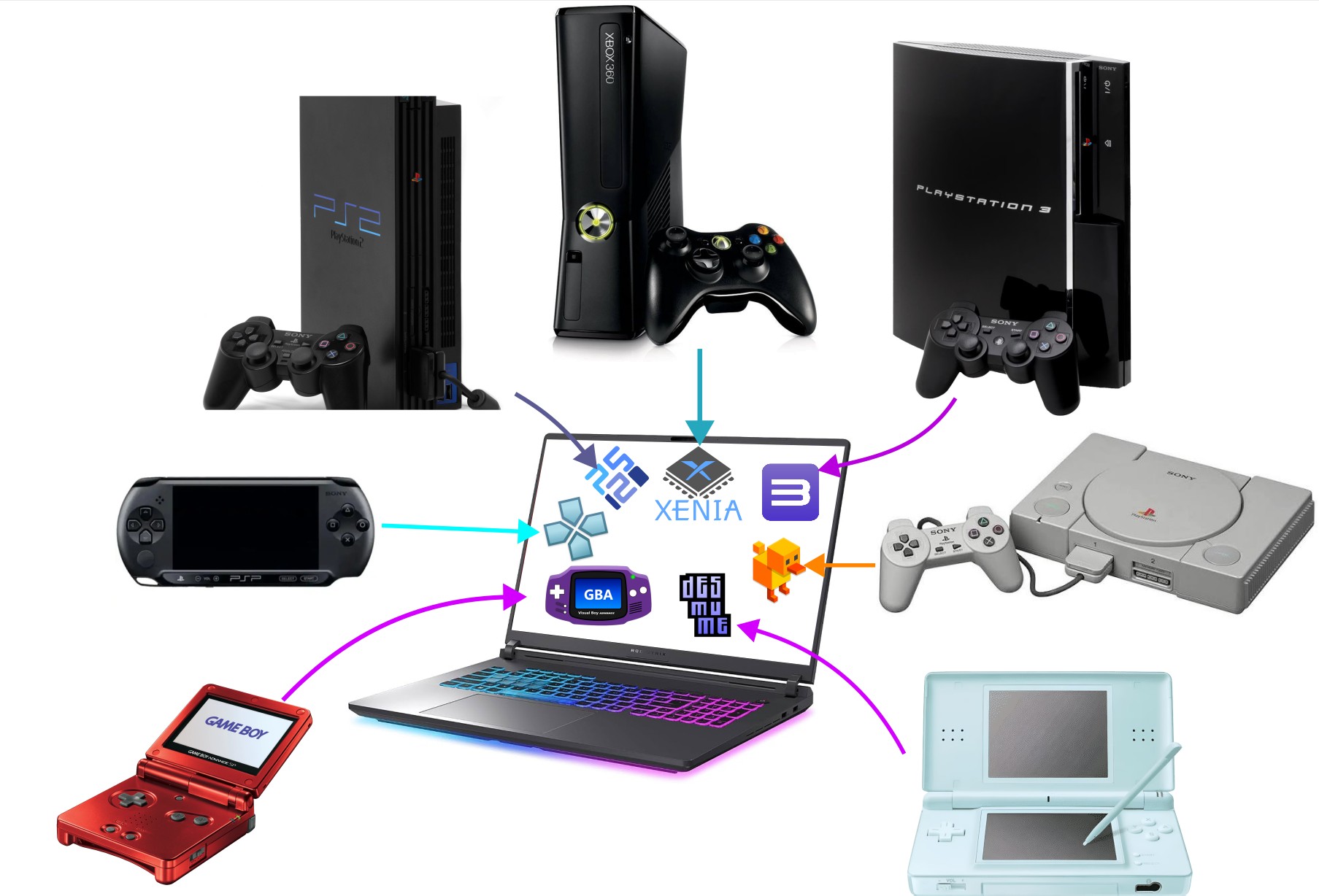
Introducing game emulation, a way to play console-only games on PC. In technical terms, game emulators are softwares designed to simulate the behaviour of a gaming console, which essentially tricks the game into thinking that it is running on its native console. Some might confuse emulation with virtualization but that is wrong. Some very popular game emulators are Visual Boy Advance for the GameBoy Advance, Xenia Canary for the Xbox 360, RPCS3 for the PS3, PCSX2 for the PS2, DeSmuME for the Nintendo DS, PPSSPP for the PlayStation Portable, Duckstation for PS1, and other alternatives.

Modifying game files has led to groundbreaking game concepts and the scourge known as cheating in online multiplayer. As discussed earlier, we have the recently released into early access Wardogs, the old faithful Stanley Parable, the Half Life 1 fan-made remake Black Mesa, the list keeps going. The openness of PC has allowed fans to modify game files and create new experiences altogether using their favourite games as bases. Stalker Anomaly is an example of a stand-alone sandbox made from taking inspiration from the Stalker series developed by GSC GameWorld. Bethesda games like the Elder Scrolls and Fallout are known for their extensive modding scenes. Arma has the King of the Hill mod and the battle royale mod which helped spawn the entire fighting in a large map with a shrinking zone gameplay. Cyberpunk 2077 has mods that completely change the way the game can be experienced with Night City Alive, Law Enforcement Overhaul, Gunsensical, Drug Dealer, and various othe gameplay changes.
Sites like Nexus Mods, ModDB, Mod.io, GameBanana are some trusted mod hosting sites. Modding a game can change the way the game is played and also gives a reason for players to stick around long after release. Consoles with their closed ecosystems do not support modding game files unless allowed by developers, Skyrim and Fallout 4 have some curated mods which do not allow script extenders.
What if a developer needs money early for continued game development? Early access is a way where a developer can sell their game and receive money and feedback directly from the players. New Blood Interactive has made this business model their entire backbone. Famous early access titles are the aforementioned Wardogs, Selaco, Ultrakill, BeamNG.drive, Phasmophobia, Lethal Company, which have made their mark before their 1.0 release. Some games that have benefitted greatly from early access to their 1.0 release are Factorio, Valheim, Subnautica, Hades, Hades 2, Baldur’s Gate 3, PUBG, Kerbal Space Program. Early access is a double-edged sword as not every game becomes a full release, some get abandoned or delayed. Star Citizen is an example of a game where there is no fixed 1.0 release point and the continuous funding and expanding scope allow development to continue for more than a decade while the game still remains in Alpha. There have been multiple games that have been abandoned like Godus (2013), Towns (2012), StarForge (2014) which never left early access and were removed from being sold.
The ugly
What is stopping a person from leveraging all of this? Why even buy a console if you can just get a gaming desktop? You will be able to do all your other work on it too. Well, the average person’s wallet is one reason. Gaming components are very expensive compared to general task devices. Throw in the global memory shortage and we have a recipe that will spell doom for your budget. An entry-level component in gaming is considered to be a relatively inexpensive part designed primarily for basic gaming and graphics workloads, typically targeting 1080p gaming rather than high-resolution or high-end performance. An entry level build might look like:
| Component | Name | Price (INR) |
| CPU | NVIDIA GeForce RTX 3050 8 GB | 30,000 |
| GPU | Intel Core i3-12100F | 11,000 |
| Motherboard | H610 | 7,000 |
| RAM | 16 GB DDR4 (2×8 GB) | 7000 x 2 |
| Storage | 1 TB NVMe SSD | 17,000 |
| PSU | 500–550 W | 1,500 |
| Case | Basic airflow-focused ATX/mATX case | 4,000 |
The total comes out to be: INR 84,500. Comparing this to a INR 50,000 PS5 console is not a difficult decision. Gaming laptops are even costlier and perform poorly compared to their desktop counterparts due to their size. Games are released in unfinished and buggy states that may hamper game performance are problems occuring on PC. For a casual audience, the console remains the king of gaming hardware.
The openness of PC also allows the rampant spread of cheaters and hackers in online multiplayer games. To combat this many anti-cheats like Riot Vanguard, EA Javelin, BattlEye, RICOCHET, Easy Anti-Cheat have kernel level access to your system. The fundamental concern regarding this system is “why is a game company software getting the same access to the general privilege level as other extremely trusted system software.” A vulnerability in a kernel driver can potentially have a much more serious consequence than a vulnerability in an ordinary game executable. Kernel level access can provide access to your personal files. So you have two options here: a) either have a slightly less trusted experience in online multiplayer when there is no kernel anti-cheat; b) trust the game company to make a kernel level anti-cheat that is secure and the company itself does not misuse the access you have given them.

Piracy is an issue for game companies ever since the advent of paid software. License documents can be spoofed allowing unrestricted access to otherwise expensive software. A launcher like Good Old Games (GOG) provides games with no digital rights mangament (DRM) required. No DRM means there are no license files attached with it. Game companies have turned towards Denuvo for protection against pirates. Denovo is an anti-tamper software that constantly checks if the integrity of the game has been compromised or not. It modifies the game’s binary and protects selected portions of its code using techniques such as obfuscation, code virtualization, encryption and integrity checks. This constant checking and encrypting bogs down game performance with many older systems not able to perform as expected on games where they surpass the minimum hardware requirements.
Desktop PCs are huge and gaming rigs take up even more space. Add in your peripherals and say goodbye to traveling with it. Laptops are far pricier and while gaming their battery life is shorter than a processors width. What if someone travels a lot and would like to play some modern games?
Handheld gaming
The long hours during travel or going away from your home system usually meant the end of your gaming time for that temporary period. Well not anymore due to the wide range of handheld gaming devices.
Where handheld started
One device able to play multiple games seems like common sense in this day but that was not always the reason. Before true cartridge-based handheld consoles, companies produced dedicated electronic games. A major early example was Mattel’s Auto Race (1976), followed by games such as Football. These were essentially single-purpose electronic devices: the hardware contained the game, and there was no interchangeable game library. Nintendo later entered this space with Game & Watch in 1980 and never looked back.

1989 saw the release of the Game Boy. Instead of selling a device with one game permanently built into it, Nintendo created a cartridge-based ecosystem. You could buy one handheld and continually expand its library. The hardware was not mind-blowing and the games looked pretty ugly with an 8-bit CPU, a monochrome 160×144 display with 4 shades of gray. Nintendo focused more on battery life and affordability than raw graphical power. Tetris became the most popular game on the GameBoy before the next giant.
Sega took a different turn with their handheld, the Sega Game Gear, released in 1990. The Game Gear had some significant technical advantages over the Game Boy like more powerful hardware, full-color screen, and backlit display. The increase in raw power also led it to consume batteries far faster than the GameBoy. The 1990s saw quite a few competitors vying for Nintendo’s throne like the Atari Lynx, NEC TurboExpress, SNK Neo Geo Pocket, and Bandai WonderSwan, all to no avail. Nintendo had a far superior software ecosystem.
Pokémon Red and Green/Blue in 1996–1998 changed the market. The Game Boy became a social device with the introduction of trading and multiplayer components which encouraged connecting multiple Game Boys. Nintendo enjoyed dominance over its competitors till a new challenger stepped in with something different to offer.

Sony decided to change the handheld strategy. Instead of an inexpensive, efficient and simple approach, let us try to bring the Playstation experience to a handheld device. The PSP had a 4.3-inch 480×272 display, powerful hardware for its time, 3D graphics, Wi-Fi, and Multimedia capabilities. It could play games that looked much closer to PS2-era games than traditional handheld games. Sony made the first premium handheld device.
Nintendo responded with the Dual Screen (DS). Along with its two 256x 192 screens, it had a stylus, touchscreen, microphone, wifi, and the usual buttons. In raw power the PSP was ahead. In terms of the potential of the device to appeal to non-gamers and gamers alike, the DS was leagues ahead. As we saw in Part-1, the DS went on to become one of the best selling gaming systems ever. Nintendo and Sony both released successors to their handheld devices: the 3DS, and the PS Vita. The PS Vita bombed out and the 3DS sold very well. Funny enough their competition would be against a platform not made for gaming.
The launch of the Apple iPhone in 2007 and the rapid expansion of Android phones changed the game (no pun intended). Dedicated gaming handheld competing with multi-purpose devices already present in your pocket, this was a competition that handhelds were destined to lose. Nintendo changed tracks to create a portable console instead. The Switch was marketed as a home console you could take with you. Add in Nintendo’s expansive game library and you had a match made in heaven with an upwards of 155 million units sold till the end of 2025.

After the release of the Nintendo Switch in 2017 it seemed like Nintendo had the handheld system market on a lock, that is, until the release of the Steam Deck in 2022. The Steam Deck is a small PC run using SteamOS, a Linux-based operating system focused on gaming. Handheld PCs existed before the Steam deck, from companies such as GPD, AyaNeo and OneXPlayer, but they were relatively niche products. The Steam Deck popularized it.
Was this Valve’s attempt to snatch dominance from Nintendo? Not really since both cater to different markets. Nintendo’s first party games will never show up on Steam so the only place to play those games are on the Switch. Steam Deck has the advantage of leveraging the entire Steam library using one handheld device. Valve is working with game developers to make games Steam Deck verified, a guarantee that it works well on the Deck.
Just how many handheld gaming devices are there?
The advent of the Steam Deck showed companies that there was a market for handheld PCs. The Steam Deck had an estimated 1.6 million sales in 2022. Companies like Asus, MSi, and Lenovo jumped on this opportunity to release their own version of these devices. Do understand that due to the size of these devices none of them possess ray tracing or upscaling capabilities.
You know things in the electronics industry are bad when handheld PCs start costing higher than gaming desktops. I mean USD 1,000 is excessive for a small gaming system. The main advantage of such a system is the complete PC package in a portable system which needs no desk or peripherals. You get a complete package with monitor, speakers and controls in the size of a rather large phone. The disadvantages are quite similar to mobile gaming.
Gaming on your phone
Mobile gaming has taken the world by storm. People who were not into gaming or could not afford expensive hardware have decided to increasingly invest on the newset phone for higher performance on Call of Duty Mobile or PUBG mobile.
History of mobile gaming
Mobile gaming has a surprisingly long and storied past. The GameBoy demonstrated the popularity of portable gaming. The ultimate portable device is the phone in your pocket. The first game on the phone was Tetris (of course) on the Hagenuk MT-2000, released in 1994. Then came the big one: in 1997, Nokia introduced Snake on the Nokia 6110. How did a simple game of making a snake eat pellets and not crash into itself become so popular? The answer is quite simple, the phone was always in your pocket. Riding on the bus, waiting in a lobby, or at any moment you had time to spend, you could just take your phone out and control the progressively longer snake.

Java ME (J2ME) allowed mobile versions of games like Assasin’s Creed, FIFA, Prince of Persia, Need for Speed, the Sims, Asphalt and other simple platformers and puzzle games could be downloaded. Unfortunately every phone had different, screen resolutions, buttons, processors, operating systems, and memory limitations. Developers had to make different versions of the same game for different handsets, which as you can imagine, is extremely inefficient.
Apple unveiled the iPhone in 2007 which changed the gaming landscape on mobile. A powerful ARM processor, touchscreen, relatively sophisticated OS and standardized hardware gave game developers a far bigger playground. The introduction of the App Store radically reduced the barrier between developers and consumers. The distance between you and a game was just one tap away. Games like Doodle Jump, Cut the Rope, Fruit Ninja, and Plants vs. Zombies were released to the hungry public. Angry Birds became the symbol of mobile gaming, a game that has since turned into an entertainment brand with movies, toys, merchandise, books, and theme park attractions.

Free-to-play (F2P) games were around for a long time. The model emerged prominently in Korean and Chinese PC games in the late 1990s and early 2000s. The idea was that instead of charging for the game, companies made the game free to download/play and earned money through things like: virtual currency, items, character customization, and gameplay advantages. Riot’s League of Legends is the most popular early F2P title, releasing in 2009. This business model existed before mobile gaming, but it exploded in popularity due to mobile. Games like Clash of Clans and Candy Crush were and still are the biggest names in the mobile F2P space.
Candy Crush is an extremely important example in showcasing the power of mobile gaming. It was designed around: very short levels, easy controls, and constant progression, stuff that is very appealing to people who do not spend time in games. It shows the target audience of gaming shifting to anyone who owns a mobile phone. Nintendo 3DS was a commercial success but felt the shockwaves caused by mobile gaming. The PS Vita was stranded between two giants and faded away.

Mobile games were trying to emulate the feeling of large console and PC games like Modern Combat, N.O.V.A, Asphalt, with some games being released from the original developers like FIFA 14,15, and 16, Need for Speed Most Wanted, and others. These were considered a bonus but was never meant for serious gaming. This changed in 2018 with the release of PUBG mobile. PUBG on the PC was very popular, bringing it to mobile exposed the game to a very large audience. The game became a smash hit with 10 million daily active users (DAUs) globally (excluding China) after a short two months. The estimated count for 2026 is 25 to 30 million DAUs. Fortnite and Call of Duty jumped at the opportunity and released their own mobile version of games.
The mobile gaming sphere is isolated no more with huge releases like Tom Clany’s Rainbox Six Seige, The Division Resurgence, Genshin Impact, and Resident Evil 4 Remake, games that are available on console and PC alike. Cross platform gaming could accommodate another platform since modern flagship phones can have performance approaching, or in some workloads exceeding, older dedicated gaming hardware.
Mobile gaming e-sports have become prevalent with the biggest names being PUBG Mobile Global Championship (PMGC), Free Fire World Series (FFWS), Call of Duty: Mobile World Championship, and Brawl Stars World Finals.
Handheld and mobile shortcomings
Mobile gaming seems to be the most easiest to enter and with the lowest barrier of entry up until now. What does it cost? Your mobile hardware is put under extensive pressure when playing games with high graphical demands. Consoles and PCs have very good thermal management schemes allowing eassy dissipation of heat, which at times still is not enough. The small phone in your hand does not have the thermal dissipation required for sustained performance. Your framerate keeps slipping because your device cannot remove heat quickly enough.

The two graphs show how temperature affects the aging of Li-ion batteries when the cells are stored at 50% state of charge (SOC). In graph (a), the capacity loss becomes greater at higher temperatures, meaning the battery loses more of its ability to store energy as it ages. In graph (b), the internal resistance also increases more at higher temperatures. Higher internal resistance means the battery has more difficulty delivering current and produces more heat during operation. The different curves represent cells at different states of health (SOH), or different stages of aging. Overall, the graphs show that higher temperature accelerates battery degradation, causing both capacity loss and resistance increase.
Okay sure the framerate slips, but that is it right? Exposure to high temperatures can degrade components very quickly. There is a separate dimension here too; to generate that much heat, the SoC has to take a lot of power from the battery. Battery drainage increases significantly, the combination of fast drainage and exposure to large amounts of heat will degrade your battery at a far faster rate when compared to regular usage. Mobile gaming will reduce the life of your device unless you change batteries or buy a special gaming phone. The price you pay for gaming on your phone is your phone.
Wish there was a method where I could play big games without owning hardware that has the same price as a millionaire’s net worth.
Game Streaming / Remote Play / Cloud Gaming
A fast internet connection is cheaper to get than a new computer and far less cheaper than a gaming computer. Sending your inputs through a network instead of to your gaming device solves the problem of portability and rising hardware prices. The problem it introduces is latency.
Game streaming is the general process of sending a game’s video/audio output from one device to another over a network while sending the player’s controls back to the device running the game. Game streaming is the umbrella term. Remote play and cloud gaming are two major forms of game streaming.
Remote play is game streaming where the game is running on your own gaming device, such as a PC or console, and its output is streamed to another device. Cloud gaming is game streaming where the game runs on a remote company’s server/data center rather than on a gaming device owned by the player.
Here we go again
Sony Remote Play (2004) was the first stab at streaming games. The idea was to stream PS3 games on the PSP. The PS3 did all the rendering and heavy lifting while you gave the inputs to your PSP. Sony continued this idea with PS Vita in 2012 but slowly abandoned this version.

The first instance of cloud gaming was attempted by OnLive in 2010. The OnLive MicroConsole sent your controller inputs to their servers where they sent the video to you. They showed that it could be possible but internet speeds were not what they are today. A small lag or packet loss in sending or receiving can make the difference in you winning or losing. Streaming movies and videos does not have the same problems as streaming games.
The next few devices were focused on game streaming rather than cloud gaming. They all worked similar to Sony Remote Play in that you need a local device playing the game, the game was not being streamed from an external server. Playstation TV for the PS4, Nvidia Shield and Steam Link for the PC. Dedicated streaming boxes were not making commercial sense since streaming does not require extensive hardware.

Google Stadia (2019) was the next big attempt at cloud streaming. Google’s servers would process the inputs that you gave. This attempt was marred by bad decisions all around. Google tried to make this game into a platform by selling games individually and not as a subscription service where you could access the library. The customer would keep the game only as long as Stadia was running (foreshadowing). Google initially created Stadia Games & Entertainment (SG&E) to develop first-party games, which was shut down in 2021. This meant no first party games on the Stadia, rely completely on third party developers. Stadia had a software infrastructure problem, developers had to create a version that worked on Stadia infrastructure, which used a Linux/Vulkan-based environment which created additional development work. By 2022, Google was increasingly interested in licensing the underlying streaming technology rather than running Stadia as a consumer gaming platform. Stadia shut down in 2022.
In 2020, Xbox Cloud Gaming was introduced. Microsoft integrated cloud gaming into the Game Pass. No need for separate game purchases. Nvidia Geforce Now (2020) has the same strategy of cloud gaming, the difference is that the games you can play are ones that you already own on a digital store like Steam, Epic etc. You pay rent to run games on their hardware.
The Logitech G-Cloud (2022) and the Playstation Portal (2023) are handheld hardware which supports remote play and cloud gaming. Logitech G-Cloud supports PC, Xbox, and android gaming whereas the Playstation Portal is only for the PS5.
Really that good?
It seems like a good and relatively inexpensive solution right? Sure you will use a ton of internet data and will need to upgrade your plan but it seems reasonable. What happens if your internet becomes unstable? There is no offline gaming provision when using cloud services. No multiplayer games for you since the other players will beat you purely in terms of input latency.
You depend on the provider having enough server capacity. During busy periods, access or quality can potentially be affected. Additionally ,a game can be removed from a cloud library because of licensing agreements, just as streaming movies disappear from Netflix, GeForce Now being exempt from this issue. If a service shuts down, you can say goodbye to gaming. Cloud services may restrict which games can be streamed, even when you own those games if the the appropriate technical setup is not present.
Cloud gaming should be looked at as a companion feature rather than a primary way of gaming due to the unpredictability associated with it. Remote play is a companion piece by design so it is free from subscription worries. The only problem with remote play is that you need to own the hardware. The unpredictability seems a bit more consumable now.
Are you winning, son?
The 9,000+ word journey through part 1 and part 2 of gaming wars can conclude with only one message. Game in the way that is economically feasible and physically possible to you. There is a game out there where you will feel at home, that game might be or has been made by a big studio or a solo developer. Play what you enjoy and how you enjoy, this hobby is not cheap for anyone involved.
Related Posts
Frequently Asked Questions (FAQ)
Ques: What are live service games?
Live service games are games designed to receive continuous updates, new content, events, and features long after their initial release. They often have seasonal content, battle passes, online multiplayer, or in-game purchases. Examples include Fortnite, Destiny 2, and Apex Legends.
Ques: What are early access games?
Early access games are games released to players before they are fully completed. Developers use player feedback, bug reports, and testing to improve the game while it is still being developed. The game may change significantly before its official full release.
Ques: What is game emulation?
Game emulation is the process of using software to imitate the hardware and operating system of another gaming platform. An emulator can, for example, allow a PC to run games originally designed for a PlayStation, Nintendo, or older console. The performance and legality of emulation depend on the specific system, game, and how the game files are obtained.
Ques: What is DRM?
DRM, or Digital Rights Management, is technology used to control access to digital games and other media. In games, DRM can require a license check, online activation, or connection to an account before a game can be played. It is intended to reduce unauthorized copying and distribution.
Ques: What is Denuvo?
Denuvo is a commercial anti-tamper and DRM technology developed by Irdeto that is used by many game publishers. It is designed to make unauthorized modification and piracy more difficult, particularly around a game’s release. Because it operates alongside the game, some players and developers have debated its effects on performance and long-term access.
Ques: What is latency?
Latency is the delay between an action and the corresponding response in a game. For example, when playing an online shooter, latency is the time between pressing a button and seeing or receiving the resulting action. It is commonly measured in milliseconds (ms), with lower latency generally producing a more responsive experience.
Ques: What is game streaming?
Game streaming is a method of playing a game while the game’s video is transmitted to your device over a network. The game itself may be running on another computer or console, while your device receives the video and sends your controls back. Game streaming can refer to both cloud gaming and streaming from your own hardware.
Ques: What is remote play?
Remote play allows you to play games running on your own console or PC from another device over a network. For example, a PlayStation can run the game while its video is streamed to a phone, tablet, or PC. Unlike cloud gaming, the game normally runs on hardware that you own.
Ques: What is cloud gaming?
Cloud gaming runs games on remote servers in data centers and streams the resulting video to the player’s device. The player’s controller inputs are sent back to the server, which processes them and sends back the updated video. Services such as Xbox Cloud Gaming and NVIDIA GeForce NOW use this approach, allowing games to be played without requiring a powerful gaming PC or console.

Leave a Reply