
Gaming has come a long way, from a niche fascination to a global giant. The rise of video games and interactive media alike has been nothing short of metoeric with the invaluable help of innovations in electronics and semiconductor manufacturing. The good old war of consoles has subsided with the increase in cross-platform multiplayer games which allows people on all consoles to play together. COVID-19 gave gaming an unprecedented boost due to people staying at home with nothing better to do.
Yet here we are at a point in gaming where it seems that no platform can do justice to their hardware. Games are being released in absolutely unplayable states and the promise of 4K gaming is just upscaling a lower resolution. Let us look at some of the biggest names in the industry and dissect their hardware.

Playstation: Sony’s exploitation forum
The most popular console to exist, the Playstation by Sony. With Atari fading in the background after their Jaguar (1993) failure and the Nintendo 64 battling Sega Saturn, the Playstation launched in 1994 offering CD-ROMs instead of the good old cartridge. The Playstation launched due to a failed collaboration with Nintendo where Sony was asked to develop CD-ROMs for the Nintendo SNES.
Playstation was the one-stop shop for third party developers. Classics like Resident Evil, Metal Gear Solid (MGS), Gran Turismo, Tomb Raider, and Crash Bandicoot just to name a few skyrocketed the Playstation’s popularity. The console was already priced at USD 299 compared to Saturn’s USD 399, the big boost received from such fantastic titles only strengthened their hold on the market.
The absolute behemoth that was the Playstation 2 arrived and swept the market with around 150 million sales during its lifetime. It acted as a DVD player and a game console. Game developers like Konami, Rockstar, Capcom, Square Enix, Bandai Namco and the others had a blast with this console releasing legendary games like Devil May Cry, Grand Theft Auto III, MGS 2, Kingdom Hearts, and so many more. The PS2 was backwards compatible with the original Playstation, people could play PS1 games on the PS2.
Sony had a small foray into the handheld market with the Playstation Portable (PSP). It was a commercial success with 80 million copies sold and some great exclusives like GTA Vice City Stories, GTA Liberty City Stories, and God of War Ghost of Sparta. Quite a shame they never went back into that space due to the behemoth called the Nintendo DS.

The PS3 initially stumbled at launch due to releasing an year after the Xbox 360 and pricing higher than its competition. Its unusual hardware architecture made game development difficult. Sony recovered from the adversity and learnt their lesson when releasing the PS4. Atleast the PS5 can play PS4’s games since the PS5 is pretty short on games.
| Specification | Base PS5 | PS5 Slim | PS5 Pro |
| Launch | 2020 | 2023 | 2024 |
| CPU | AMD Zen 2 | AMD Zen 2 | AMD Zen 2 |
| CPU Cores/threads | 8/16 | 8/16 | 8/16 |
| CPU frequency | Up to 3.5 GHz | Up to 3.5 GHz | Up to 3.85 GHz |
| GPU Architecture | Custom AMD RDNA 2 | Custom AMD RDNA 2 | Upgraded AMD RDNA 2 |
| GPU Compute Units | 36 | 36 | 60 |
| GPU Clock | Up to 2.23 GHz | Up to 2.23 GHz | Up to 2.18 GHz |
| FP32 Throughput | ~10.28 TFLOPS | ~10.28 TFLOPS | ~16.7 TFLOPS |
| System RAM | 16 GB GDDR6 | 16 GB GDDR6 | 16GB GDDR6 + 2GB DDR5 |
| RAM Bandwidth | 448 GB/s | 448 GB/s | 576 GB/s |
| Internal SSD | 825 GB | 1 TB | 2 TB |
| SSD Raw Read | 5.5 GB/s | 5.5 GB/s | 5.5 GB/s |
| Wi-Fi | Wi-Fi 6 | Wi-Fi 6 | Wi-Fi 7 |
| Optical Drive | Disc/Digital variants | Detachable drive | Optional detachable drive |
| Ray-Tracing | Hardware accelerated | Hardware accelerated | Faster RT |
| AI Upscaling | N/A | N/A | PSSR |
| Max-rated PSU | 350 W | 350 W | 390 W |
AMD’s custom system-on-chip (SoC) allows the CPU and the GPU to be manufactured into one package. The PS5’s architecture shares the RAM storage between the CPU and the GPU, they do not have their own dedicated memory. The GPU and CPU share from the same pool of 16 GB GDDR6.
Playstation’s saga has not been short of controversy, with removing backwards compatibility on the PS3, PSN hacks in 2011, resisting cross-play and making online multiplayer gaming into a paid service. Their regular forays into live service titles has managed to give us a humongous success in Helldivers 2 and an abysmal failure in Concord. The Sony of 2026 has decided to keep shooting themselves in the foot with quite a lot of baffling decisions.
The first came in the form of stopping first party singleplayer releases to PC, this was comparatively easier to digest considering the ocean of PC gaming. The second is a far bigger attack on consumers due to how enthusiastically Sony was initally against it; Sony will no longer produce Blu-Ray CDs for their games after 2028. This means no more physical releases for the Playstation. This video from PS aged pretty badly. A survey shows just how many people are interested in buying digital-only games. Rockstar has embraced this change by selling GTA 6 physically with a code in a box. Let me list out the problems of keeping games digital-only:
- No second-hand market: Digital games do not have a resale value since there is nothing physical to sell. A game that you bought in a physical format might have cost you INR 5,000 but it can be further sold for half its price to a game store. A digital copy is essentially worthless in regards to getting money back.
- Consumers will have lower choice: In this economy, living has become quite difficult and spending money on luxuries like gaming is a challenge. The second-hand market gave people a lower entry barrier by buying used games at a lower price. An all-digital market will destroy this aspect of physical releases.
- Game preservation is threatened: A Deadpool game was released in 2013. It was developed by Highmoon Studios and published by Activision. It was delisted from all digital storefronts on 16 November 2017. Buying it and playing it legally is completely impossible unless you find a dusty used CD in the corner of a gaming store. This is the fate that has befallen many games.
- Removal of games from library: In 2023, Ubisoft decided to delist The Crew from all digital storefronts and also revoke the licences of people who bought it. This sparked heavy backlash and ignited the Stop Killing Games movement. Sony has a bit of a history of revoking digital purchases, In 2022, Sony announced that customers in Germany and Austria would lose access to hundreds of StudioCanal films they had previously purchased through the PlayStation Store. In Germany, 314 pieces of content were affected, and another 137 in Austria. Titles included John Wick, Apocalypse Now, Django, Saw, La La Land, and others. Sony attributed it to changes in its licensing agreements. This was controversial because Sony had previously announced that it was stopping new movie and TV purchases/rentals through the PlayStation Store in 2021, but said customers would continue to have access to content they had already purchased. Sony did the same thing again in 2026 to UK users, they would lose access to 551 previously purchased StudioCanal movies and TV shows because of licensing arrangements. The affected titles include Terminator 2, Paddington, Pan’s Labyrinth, Rambo, Total Recall and others.
- Sentimental value: This point is far more of a personal point of view. I like to see my games collection in the from of a tower or a shelf of disks and I am sure many gamers out there are similarly attahced to their gaming collections. It acts as a sort of gaming photo album for many of us.

Sony’s decision to cut funding to a Kojima Productions game titled “Physint” has reached the news. It was a spiritual successor to Metal Gear Solid, a game series that had played a huge role in extending Playstation’s influence. The bigger joke is that Kojima Productions now has a new publisher, a publisher with whom they have been at odds since the turn of the millenium, Microsoft’s Xbox.
Xbox: Microsoft’s dumpster fire
The Xbox 360 was the second console that I had ever owned and will be my last. Couch gaming with this console was a different experience altogether, one that is getting more difficult to capture with the continued rise of online and live-service gaming, but that is a story for another time.

Playstation has taken over the gaming space, leaving Microsoft worried about their Windows-based PC ecosystem. To turn the tide in their favour the Xbox was released in 2001. The biggest draws of that console were Halo: Combat Evolved, Forza Motorport, Tom Clancy’s Splinter Cell and Rainbow Six series. The release of Halo 2 increased the Xbox’s popularity due to the realization of Xbox Live’s potential. Live voice chats and online matchmaking worked as an amazing foil to Playstation’s focus on single player games.
The Xbox 360 showed up with quite some expectations in 2005. It sold about 1.5 million units by the end of 2025. Unexpectedly enough, the early owners were in for a bit of a curveball, hardware failures caused the Xbox 360 to show flashing red lights around the power button. This phenomenon was dubbed as the “Red Ring of Death.” The problem kept occuring all the way till July 2007 when Microsoft announced that they will extend warranty coverage to three years and a $1.05–$1.15 billion pre-tax charge to cover the expected repair/replacement costs.

You minght think that this caused Microsoft’s downfall in the console platform, but we would not be talking about the Series X if it were not for the 360’s overall success. The console went on to sell around 84 million units worldwide with gaming giants such as Halo 3, Gears of War, Forza Horizon and Motorsport sequels, and the ever infamous Call of Duty multiplayer lobbies acting as a real life version of Twitter discussions, allowed the 360 to go far beyond the PS3. Kinect was released in 2010, a system acting as a companion for the 360 where the player can use their body movement and voice. Kinect sales reached 24 million units during its lifetime. The Kinect was Microsoft’s response to Nintendo’s Wii.
The thing about large companies is that they always seem to learn the wrong lessons when moving onto next generation hardware. Sony with its overcomplicated PS3, Google’s misguided Stadia, Nokia’s Windows phone failure and Amazon’s couldn’t catch Fire Phone, and another failure that we can add to this list is the Xbox One. Microsoft looked at Kinect’s success and made an all-in-one entertainment system with Kinect packaged at USD 499, the PS4 was priced at USD 399. The public wanted a better Xbox 360 and got an inferior Wii bundled with Microsoft’s ridiculous decisions.
In the original May 2013 announcement, the Xbox One needed to be connected to the internet periodically, the limit was 24 hours for offline play and 1 hour if the person was sharing games on another person’s Xbox. If one did not meet this criteria then you could not play offline anymore. Oh but apparently you could still watch movies and TV series through Blu-ray, the Xbox One becomes a very expensive DVD player after 24 hours offline. Game sharing became an issue where giving a CD to a friend would mean that the original owner could no longer access that game. These baffling decisions damaged the goodwill built by the 360, the decision were reversed quickly but trust once broken is difficult to get back. The PS4 stormed the market and dominated Xbox, PS4’s 117 million sales till 2023 versus the One’s 58 million sales. The Xbox Series X and S had a smaller customer base to cater to.
| Specification | Xbox Series X | Xbox Series S |
| Launch | 2020 | 2020 |
| CPU | Custom AMD Zen 2 | Custom AMD Zen 2 |
| CPU Cores/threads | 8/16 | 8/16 |
| CPU frequency | Up to 3.8 GHz | Up to 3.8 GHz |
| GPU Architecture | Custom AMD RDNA 2 | Custom AMD RDNA 2 |
| GPU Compute Units | 52 | 20 |
| GPU Clock | Up to 1.825 GHz | Up to 1.565 GHz |
| FP32 Throughput | ~12 TFLOPS | ~4 TFLOPS |
| System RAM | 16 GB GDDR6 | 10 GB GDDR6 |
| RAM Bandwidth | 560 GB/s (10 GB) + 336 GB/s (6 GB) | 224 GB/s (8 GB) + 56 GB/s (2 GB) |
| Internal SSD | 1 TB | 512 GB / 1 TB |
| SSD Raw Read | 2.4 GB/s | 2.4 GB/s |
| Wi-Fi | Wi-Fi 5 | Wi-Fi 5 |
| Optical Drive | 4K/UHD Blu-ray | None |
| Ray-Tracing | Hardware accelerated | Hardware accelerated |
| AI Upscaling | Developer/game dependant, Direct ML | Developer/game dependant, Direct ML |
| Max-rated PSU | 315 W | 165 W |
The funny thing about these specifications is that they really do not matter for the most part since the Xbox has no exclusive games. The increasing prevalence of emulation has made the backwards compatibility draw of the Series X into a relic. The Xbox is being treated more as an ecosystem rahter than a console. The Game Pass is the biggest example of this change and Xbox games being released on the PS5 like Sea of Thieves, Hi-Fi Rush, and Halo CE Remake show Microsoft letting go of exclusivity. Sarah Bond, the President of Xbox from 2023 – Feb 2026, had the ‘Xbox Everywhere’ strategy where Xbox was not just a console. The new CEO of Xbox, Asha Sharma, has made moves trying to re-ignite the old Xbox legacy with increasing focus on exclusives and the Project Helix rumours are promising a return to form for Xbox.
Nintendo: Relevant then and relevant now
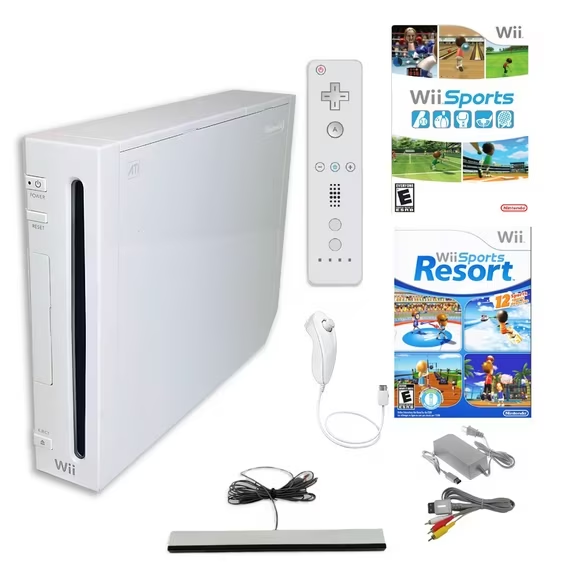
A game console and publisher that lives in its own realm. This legendary company with game IPs like Pokémon, Legend of Zelda, Mario, Animal Crossing, Metroid, Xenoblade, and so many more. These games are so famous that your entire family must have heard of them. The Nintendo Wii was my first console and the time I had playing just Wii Sports and Wii Sports Resort was amazing. Unfortunately, I was not as aware of electrical engineering as I am now so I accidently plugged it into the 240 V socket when it was rated at 120 V. Safe to say, the Wii never switched on again.

The company goes back to 1889, Fusajiro Yamauchi made traditional Japanese hanafuda playing cards in Kyoto, talk about humble beginnings. It gradually moved into toys and electronic games. By 1978, Nintendo was producing coin-operated video games, and in 1981, it released Donkey Kong, another classic. In 1983, the Family Computer (FAMICOM) was released in Japan. It was redesigned and sold as the Nintendo Entertainment System (NES) to the North American audience in 1985.
Atari was the dominant name in North America form the late 1970s to the early 1980s with classics like Space Invaders and Pac-Man. The North American video game crash of 1983 provided the platform that Japanese console companies needed to get into the market. Nintendo opened the gates with NES and Super Mario Bros. being its definitive title, meanwhile Sega launched its Genesis/Mega Drive in 1989 with the aim of marketing itself as for the cooler/older gamer. Sonic the Hedgehog was Genesis’ main draw and so began the Mario versus Sonic rivalry.
While the Sega v/s Nintendo debacle was going on, Sony became the new challenger with the Playstation. Sony used the CD-ROM technology they were developing for Nintendo, against them and won the generation over Nintendo’s N64. The GameCube in 2001 had a very strong catalog of games but could not hold its weight against the new generation of Xbox and Playstation. Nintendo was to blame due to weak third party support, the frequency of games did not justify the USD 199 price tag, alongside no multimedia support.
There is one aspect of gaming that we have been missing for some time, the handheld market. Nintendo was stomping the competition since 1989 with the GameBoy and its bundled-in game Tetris. In 1996, its new partner in crime Pokémon started taking over in an even greater fashion with Pokémon Red/Blue becoming instant hits. The GameBoy Colour and the Advance only served to further this popularity with backwards compatibilty and modern upgrades.

Sony came after this dominance with the PSP in tow. Nintendo responded with something completely different and still unique to this day, the Dual Screen (DS). As the name suggests it had two screens and a stylus one could use to play games on the small system. This was the only system at that time which appealed to gamers and non-gamers. Instead of fighting enemies, one could care for a virtual dog in Nintendogs. Brain Age gave you puzzles and problems to solve, acting like a brain training device. Dr. Mario and Animal Crossing with simple and straightforward gameplay only served to extend the DS’ dominance among non-gamers. With a lifetime sales of over 150 million units, it remains as one of the biggest handheld devices ever made. The 3DS followed which gave an upgrade to the DS in the form of glasses-free stereoscopic 3D. This meant that your left and right eyes receive slightly different images which makes your brain perceive 3D depth.
Nintendo looked at the philosophy of anyone picking up and playing a game and went forward with creating a new console. The Nintendo Wii released in 2006 with a completely different control set compared to the Xbox and Playstation. The Wii remote was unique as one could use the same actions one used in real life to play the game. You swung the controller to play tennis, you fought with swords, you boxed using the nunchucks, you teed up the ball in golf, you got the idea. The Wii came bundled with Wii Sports in 2006, and in late 2009, Wii Sports Resort and the MotionPlus accessory were thrown in together. Wii found people who did not play games, it was a true family system with the total sales coming to around 101 million units.
The Wii U can be a case study on how a naming mishap created a failure. It was a completely different console where the dual screen concept was used with a gamepad and the TV serving as the visual outputs. The console did not appeal to the people who had a Wii and the similar name did not help matters as the branding was confusing. Needless to say, it was a complete failure with only 13.6 million sales, but it gave a blueprint for what is Nintendo’s modern handheld and console king.
The Nintendo Switch released on March 3, 2017. It became Nintendo’s all-in-one system. It works as a console and as a portable platform. The COVID-19 pandemic put a pep in its step and the release of Animal Crossing: New Horizons really amped the sales numbers to 152 million units by the end of its lifecycle. Docking was when you connected it to a TV and used it as a console.
| Specification | Switch 2 |
| Launch | 2025 |
| CPU | Custom NVIDIA SoC, 8× ARM Cortex-A78C |
| CPU Cores/threads | 8/16 |
| CPU frequency | 998 MHz docked / 1.101 GHz handheld, max ~1.7 GHz |
| GPU Architecture | NVIDIA Ampere |
| GPU Cores | 1,536 CUDA Cores |
| GPU Clock | 1007 MHz docked / 561 MHz handheld, max ~1.4 GHz |
| FP32 Throughput | ~3.07 TFLOPS docked / ~1.71 TFLOPS handheld |
| System RAM | 12 GB LPDDR5X |
| RAM Bandwidth | 102 GBps docked / 68 GBps handheld |
| Internal Storage | 256 GB UFS |
| SSD Raw Read | N/A since UFS not NVMe SSD |
| Wi-Fi | Wi-Fi 6 |
| Ray-Tracing | Hardware accelerated |
| AI Upscaling | Nvidia DLSS |
| Battery | 5220 mAh |
The specifications for the Switch 2 are severely weaker compared to the raw power of the PS5 and the Xbox Series X. Nintendo never had the goal of making a better console than Sony or Microsoft, they were always trying something different and something unique. The first party games offered by Nintendo are some of the best in the world, games that appeal to a wide audience without sacrificing what made it special. Nintendo is notorious for keeping old first party games at the same price and offering very shallow discounts, the problem is that the quality of these games are very high and is the only way to make full use of your device. Add in the paid online multiplayer and you have a machine that will drain money out of your pocket periodically. Gaming really isn’t as cheap as we thought it would be.
Are these your only options?
The world of gaming has blown up in an unprecedented way. More money means more options for the customer. These big console companies are just one half of the coin, your next gaming system maybe closer than you think, maybe the device you are using to read this post right now.
Frequently Asked Questions (FAQ)
Ques: What is resolution upscaling?
Resolution upscaling is the process of rendering a game at a lower resolution and then converting the image to a higher target resolution. For example, a game may render internally at 1080p and upscale the image to 4K. Techniques such as AMD FSR, Nvidia DLSS and Sony PSSR use more advanced methods to make the upscaled image look closer to native resolution while reducing the performance required.
Ques: What are compute units?
Compute units (CUs) are groups of processing resources inside a GPU that perform mathematical operations needed for graphics and other workloads. A GPU with more CUs can generally perform more calculations in parallel, although the number of CUs alone does not determine performance because architecture, clock speed, memory bandwidth and other factors also matter. AMD commonly uses the term “compute unit” for its GPU architecture.
Ques: What are TFLOPS
TFLOPS means tera floating-point operations per second and is a measure of theoretical computational throughput. One TFLOPS represents one trillion floating-point operations per second. It is used to compare GPUs, but it should not be treated as a direct measure of gaming performance due to different GPU architectures.
Ques: What is DDR in RAM?
DDR stands for Double Data Rate. It is a type of memory technology that transfers data twice during each clock cycle, allowing higher data-transfer rates without requiring the memory clock itself to run at twice the frequency. DDR has evolved through generations such as DDR3, DDR4 and DDR5, with newer generations generally offering higher bandwidth and improved efficiency.
Ques: What is the difference between DDR4, DDR5 and GDDR6?
DDR4 and DDR5 are types of system memory commonly used as a computer’s main RAM, GDDR6 is graphics memory designed primarily for GPUs and consoles. DDR5 provides higher bandwidth and improved efficiency compared with DDR4, while GDDR6 is designed for very high memory bandwidth using a GPU-oriented architecture. Modern game consoles and graphics cards therefore commonly use GDDR6 for their graphics memory, while PCs use DDR4 or DDR5 as system RAM.
Ques: Do you own digital games?
Not in the traditional sense, digital games are licensed rather than literally owned in the same way as a physical disc or cartridge. When you buy a digital game, you receive a license to access and use the software under the platform’s terms. This means access can depend on the account and platform, and in some cases games or other digital content can become unavailable if a service is discontinued or a license is revoked.
Ques: What was the North American video game crash of 1983?
The North American video game crash of 1983 was a major collapse in the video game industry, particularly affecting home consoles and game publishers. The market had become crowded with many consoles and large numbers of games, including poorly received titles, while retailers faced excess inventory and consumers lost confidence in some products. The crash caused major financial losses and contributed to Atari’s decline, although the industry eventually recovered with the arrival of systems such as the Nintendo Entertainment System.
Ques: Why does Nvidia use CUDA cores and AMD uses Compute Units?
Nvidia and AMD use different architectural terminology because their GPUs are designed around different internal architectures. Nvidia refers to its individual programmable arithmetic units as CUDA cores, while AMD groups its processing resources into larger structures called Compute Units. The terms therefore do not represent directly equivalent quantities: comparing a Nvidia GPU’s CUDA-core count with an AMD GPU’s CU count alone does not tell you which GPU is faster.

Leave a Reply